Quick answer: The best cat food for indoor cats is a complete-and-balanced adult food (look for an AAFCO statement for “adult maintenance” or “all life stages”) from a research-backed manufacturer, built on animal protein, with a calorie density you actually measure — ideally with wet food in the mix for extra water. Strong starting points include Hill’s Science Diet Adult Indoor, Purina Pro Plan Adult Indoor + Hairball, and Royal Canin Indoor Adult. But here’s what most guides skip: the word “indoor” on a bag has no regulatory definition, and the calorie content of popular “indoor” kibbles differs by roughly 40% per cup. The numbers on the label matter far more than the word on the front.
Key takeaways
- “Indoor” is a marketing term. “Light,” “lean,” and “complete and balanced” are regulated; “indoor” is not.
- Feed by calories (kcal), not by cups — and weigh kibble in grams if you can.
- Most indoor, spayed or neutered adult cats need roughly 150–300 kcal per day, depending on ideal weight and activity.
- Wet-forward feeding (wet food as the core, kibble as a measured extra) helps with hydration, fullness, and weight control.
- Indoor cats face higher risk of obesity, diabetes, urinary problems, and hairballs — the right food plus the right feeding routine addresses all four.
- Before buying anything, run your cat’s numbers through the free CatFoodCheck Cat Food Calculator.
Why Indoor Cats Need a Different Feeding Strategy
Keeping a cat indoors protects them from traffic, fights, predators, and many infectious diseases. But it also rewrites the energy equation. A cat that once patrolled territory and hunted many small prey meals a day now lives in a few rooms with a food bowl that never runs away. Add spaying or neutering — which most indoor cats have had — and you get a cat who burns fewer calories while often feeling hungrier.
The research is consistent on this point:
- Obesity is the norm, not the exception. In the Association for Pet Obesity Prevention’s 2022 survey, veterinary professionals classified 61% of cats as overweight or obese — and more than a quarter of owners believed their overweight cat was a normal weight.
- Indoor housing is a repeat risk factor. A widely cited review in the Journal of the American Veterinary Medical Association (Buffington, 2002) found that, across studies, indoor housing was associated with a 1.6- to 15.8-fold higher risk of obesity, depending on how it was measured, along with links to dental disease and lower urinary tract signs.
- Inactivity drives diabetes risk. A case-control study of 96 diabetic cats found that indoor confinement and low physical activity were significant risk factors for type 2 diabetes, while the proportion of dry food in the diet was not. A larger Swedish study of nearly 400 diabetic cats found that indoor confinement, being a “greedy eater,” and being overweight all raised diabetes risk — and among cats their owners rated as normal weight, eating mostly dry food was also linked to higher risk.
In other words, choosing the best cat food for an indoor cat is only half the job. The other half is how much you feed and how you feed it. This guide covers both.
How indoor life changes what your cat needs
| Indoor reality | What it does to your cat | Food and feeding features that help |
|---|---|---|
| Lower daily activity | Fewer calories burned | Moderate calorie density and measured portions |
| Spayed or neutered | Energy needs drop roughly 20–30%, while appetite often rises | Protein-rich food to protect lean muscle; strict portion control |
| Boredom and easy access to food | Grazing, begging, overeating | Scheduled meals, puzzle feeders, play before meals |
| Weak thirst drive plus dry diets | More concentrated urine | Wet food, water fountains, extra water bowls |
| Long grooming sessions | More swallowed hair and hairballs | Fiber blends, omega fatty acids, regular brushing |
| Stress and monotony | Urinary flare-ups, emotional overeating | Predictable routines and environmental enrichment |
The Truth About “Indoor” Cat Food Labels
In the United States, the FDA regulates pet food together with state feed officials, most of whom adopt model regulations written by the Association of American Feed Control Officials (AAFCO). Those regulations define exactly what certain words on a label must mean. “Indoor” isn’t one of them.
Here’s what the regulated terms require for cat food, as written into state rules such as North Dakota’s descriptive-terms regulation, which mirrors the AAFCO model:
| Label term | What it legally requires for cat food |
|---|---|
| “Indoor” | No regulatory definition. Any calorie level is allowed. |
| “Light,” “Lite,” “Low calorie” | No more than 3,250 kcal/kg for dry food (under 20% moisture), 2,650 kcal/kg for semi-moist (20–65% moisture), and 950 kcal/kg for wet food (65%+ moisture), plus feeding directions that reflect reduced intake |
| “Less calories,” “Reduced calories” | Must name the comparison product and state the percentage reduction |
| “Lean,” “Low fat” | Fat no higher than 10% (dry), 8% (semi-moist), or 5% (wet), with a maximum fat guarantee on the label |
| “Low carbohydrate” | Not allowed as a claim at all |
| “Complete and balanced” | Must meet an AAFCO Cat Food Nutrient Profile or pass an AAFCO feeding trial (FDA explanation) |
Real indoor cat foods, compared by calories
To show why this matters, we pulled the published calorie content of several popular dry formulas. Values below come from manufacturer and retailer listings checked on October 1, 2026; formulas change, so always confirm against the bag in your hand.
| Dry food | kcal per kg | kcal per 8-oz cup | Meets the “light” ceiling? |
|---|---|---|---|
| Hill’s Science Diet Adult (standard, not indoor) | 4,025 | 502 | No |
| Purina Pro Plan Adult Indoor + Hairball, Turkey & Rice | 3,979 | 451 | No |
| Purina Pro Plan Adult Indoor + Hairball, Salmon & Rice | 3,926 | 445 | No |
| Hill’s Science Diet Adult 7+ Indoor | 3,574 | 324 | No |
| Royal Canin Indoor Adult | 3,533 | 344 | No |
| Hill’s Science Diet Adult Indoor | 3,515 | 319 | No |
| Royal Canin Weight Care (Canadian retailer listing) | 3,227 | 255 | Yes |
| Regulatory “light” ceiling for dry cat food | 3,250 | — | — |
Three things jump out:
- Indoor formulas usually are lower in calories than standard adult food — Hill’s Indoor carries about 13% fewer calories per kilogram than Hill’s standard Adult. So “indoor” isn’t meaningless.
- But none of the indoor formulas qualify as “light.” If your cat is already overweight, an indoor food alone may not be enough.
- Per cup, the spread between indoor foods is huge: 319 vs. 451 kcal — about 41% more. Most of that gap comes from kibble density. A cup of Hill’s Adult Indoor weighs roughly 91 g, while Purina says a cup of Pro Plan holds about 113 g. Per gram, the two indoor foods differ by only about 13%.
The 40% calorie trap: Imagine a 10-lb indoor cat who needs about 218 kcal a day. On Hill’s Adult Indoor, that’s about ⅔ cup. If you switch to Pro Plan Indoor + Hairball and keep scooping ⅔ cup, your cat now gets about 300 kcal — nearly 40% more than they need, every single day. Neither food is “bad.” The mistake is swapping scoop-for-scoop. Weigh in grams, and recalculate every time you change foods.
What Makes the Best Cat Food for Indoor Cats: An 8-Point Checklist
Use this checklist on any bag or can — whether it says “indoor” or not.
1. A “complete and balanced” statement for adult maintenance
This is the single most important sentence on the label. According to the FDA’s guide to “complete and balanced” pet food, the claim means the food either meets one of AAFCO’s nutrient profiles or has passed a feeding trial using AAFCO procedures. Look for “adult maintenance” or “all life stages.” Anything marked “for intermittent or supplemental feeding only” is a treat or topper, not a diet.
Two flavors of this statement exist: “formulated to meet the nutritional levels…” (the recipe was designed on paper to hit the profile) and “animal feeding tests using AAFCO procedures substantiate…” (the food was actually fed to cats in a trial). Both are legitimate; feeding-trial claims offer an extra layer of real-world validation. The FDA also notes that endorsements and seals of approval from other organizations are not guarantees of nutritional adequacy.
2. Animal protein leading the ingredient list
Cats are obligate carnivores. They need nutrients found only in animal tissue, and they use protein for energy far more than dogs or people do. For indoor cats eating fewer calories, a protein-rich diet helps preserve lean muscle — the tissue that keeps metabolism up. AAFCO’s adult minimum is 26% protein on a dry matter basis; most quality indoor foods land well above that. Look for a named animal protein (chicken, turkey, salmon) near the top. Learn more in our guide to cat food ingredients to avoid.
3. A calorie density that fits your cat
Find the calorie content statement — usually listed as “kcal ME/kg” and “kcal/cup” or “kcal/can” (“ME” means metabolizable energy, the calories your cat can actually use). For a typical indoor adult at a healthy weight, a dry food in the mid-3,000s kcal/kg is easy to portion. For an overweight cat, look for a food at or below the 3,250 kcal/kg “light” line, or ask your vet about a therapeutic weight-loss diet.
4. Moisture
Canned food is typically 75–78% water, while dry food is about 10–12%, according to the FDA. Cats evolved to get most of their water from prey and have a relatively weak thirst drive, so moisture in the bowl is one of the most powerful tools for indoor urinary health and weight control.
5. Fiber for hairballs and fullness
Indoor and hairball formulas typically raise fiber to help swallowed hair move through the gut and to add bulk that helps cats feel full. Formulas we checked list crude fiber maximums of roughly 4–5.5%, versus lower levels in many standard adult foods. Fiber is helpful in moderation; too much can reduce palatability or nutrient absorption in some cats.
6. Taurine and other essentials
Cats can’t make enough taurine on their own, and a deficiency causes blindness and a serious heart disease. Every complete-and-balanced cat food must provide it — AAFCO’s adult minimums are 0.10% (dry) and 0.20% (canned) on a dry matter basis. You’ll usually see taurine listed in the guaranteed analysis.
7. Omega fatty acids for skin and coat
Omega-6 and omega-3 fatty acids support skin health and a glossy coat. Less dry, flaky skin and healthier hair can mean less loose fur to swallow during grooming — a quiet win for indoor cats prone to hairballs.
8. A manufacturer that does the science
The WSAVA Global Nutrition Guidelines suggest asking whether a company employs a qualified full-time nutritionist, conducts research and feeding trials, owns its manufacturing, and can share full nutrient data. We dig into this framework in our best wet cat food brands ranking. Before you buy, also check the FDA’s pet food recalls and withdrawals list.
How to Read an Indoor Cat Food Label in 60 Seconds
Step 1 — Flip to the nutritional adequacy statement. Confirm “complete and balanced” for adult maintenance or all life stages. If it’s missing, put it back (unless you’re deliberately buying a topper).
Step 2 — Find the calorie statement. Note kcal/kg and kcal per cup or can. Write it down — you’ll need it for portions.
Step 3 — Convert the guaranteed analysis to dry matter. Labels list nutrients “as fed,” which hides the water. The FDA’s method: subtract moisture from 100 to get dry matter, then divide each nutrient by that number and multiply by 100.
| Indoor dry food (example) | Indoor wet food (example) | |
|---|---|---|
| Crude protein (as fed) | 34% | 11% |
| Moisture | 10% | 78% |
| Dry matter | 100 − 10 = 90% | 100 − 78 = 22% |
| Protein, dry matter basis | 34 ÷ 90 × 100 = 37.8% | 11 ÷ 22 × 100 = 50% |
The wet food looked lower in protein on the can, but it’s actually higher once water is removed. That’s why you should never compare wet and dry labels at face value.
Step 4 — Estimate carbohydrates. Pet food labels don’t have to list carbs, but you can estimate them: 100 − (protein + fat + fiber + moisture + ash). If ash isn’t listed, assume about 7% for dry food and 2–3% for wet.
| Dry example | Wet example | |
|---|---|---|
| Protein / fat / fiber / moisture / ash (as fed) | 34 / 12 / 5 / 10 / 7 | 11 / 5 / 1 / 78 / 2.5 |
| Estimated carbs (as fed) | 32% | 2.5% |
| Estimated carbs, dry matter | about 36% | about 11% |
Carbohydrates aren’t toxic to cats, but carb-heavy diets add easy calories, and cats have limited dietary need for them. For an indoor cat watching their weight, lower-carb, higher-protein foods often make portion control easier.
Step 5 — Scan the ingredient list. Named animal proteins near the top, no onion or garlic, and no artificial colors are all good signs. Ingredients are listed by weight before cooking, so a wet ingredient like “chicken” can sit first partly because of its water.
Step 6 — Treat the feeding chart as a ceiling, not a target. Bag feeding ranges are written to cover a wide range of cats; many indoor cats need less. Some manufacturers even suggest “free choice” feeding, which is risky for cats prone to weight gain.
Coming soon to cat food bags: AAFCO’s Pet Food Label Modernization project is introducing a “Pet Nutrition Facts” box that looks more like a human nutrition label, with calories, household serving sizes, and carbohydrate information. Companies have a transition period running to roughly 2030, so you’ll see both old and new labels on shelves for a while.
Wet vs. Dry vs. Mixed: What’s Best for Indoor Cats?
There’s no single right answer, but the evidence leans in a clear direction.
| Factor | Wet food | Dry food | Mixed (wet-forward) |
|---|---|---|---|
| Water content | About 75–78% | About 10–12% | Moderate to high |
| Calories per bite | Low | High | In between |
| Fullness per calorie | High (more volume) | Lower | Good |
| Protein and carbs (dry matter) | Usually more protein, fewer carbs | Usually more carbs | Balanced |
| Urinary tract support | Strongest | Weakest | Good |
| Cost and convenience | Higher cost; spoils in the bowl | Cheapest; shelf-stable | Middle ground |
| Enrichment options | Lick mats, frozen treats | Puzzle feeders, treat balls | Both |
What the research says: One study found that indoor confinement and inactivity, not the share of dry food, predicted diabetes; another found that mostly-dry diets were associated with diabetes even in cats owners considered normal weight. The honest summary is that lifestyle and calorie control matter most, and dry food makes overeating easier. That’s why many veterinarians favor a wet-forward approach: wet food as the foundation, with a measured amount of kibble used in puzzle feeders or for convenience.
For specific wet food brands, see our ranking of the best wet cat food brands. Dental note: ordinary kibble does little for teeth. If dental health is a concern (and indoor housing has been linked to dental disease), ask your vet about diets carrying the Veterinary Oral Health Council (VOHC) seal and about tooth brushing.
Best Cat Food for Indoor Cats: Our 2026 Picks by Need
How we chose: Every pick below carries an AAFCO complete-and-balanced statement for adult cats, comes from a manufacturer that publicly documents nutrition research and quality control, and has published calorie data we could verify. We are not paid by any brand. Product formulas change — always confirm the current label.
1. Best overall indoor dry food: Hill’s Science Diet Adult Indoor
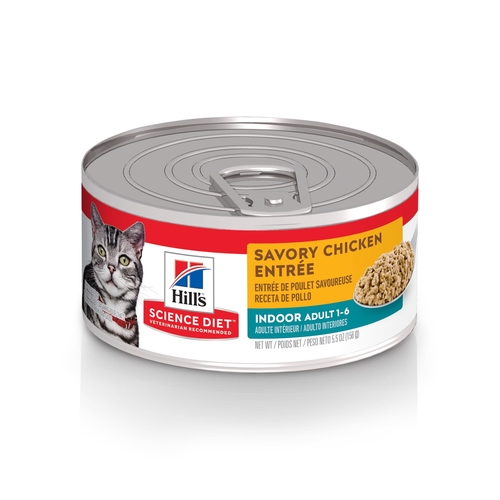
- Calories: about 3,515 kcal/kg, 319 kcal/cup — the lowest per cup among the mainstream indoor formulas we checked.
- Why it stands out: Hill’s employs board-certified veterinary nutritionists and runs one of the largest research programs in pet nutrition. This formula uses natural fiber for hairball control and is designed to support fullness between meals.
- Best for: Healthy-weight indoor adults (1–6 years) where you want forgiving portions.
- Watch-outs: Its label states it’s formulated to meet AAFCO profiles rather than feeding-trial tested. Some owners prefer named whole-meat ingredient lists; nutritionally, this formula is well-supported.
2. Best high-protein indoor food with hairball control: Purina Pro Plan Adult Indoor + Hairball
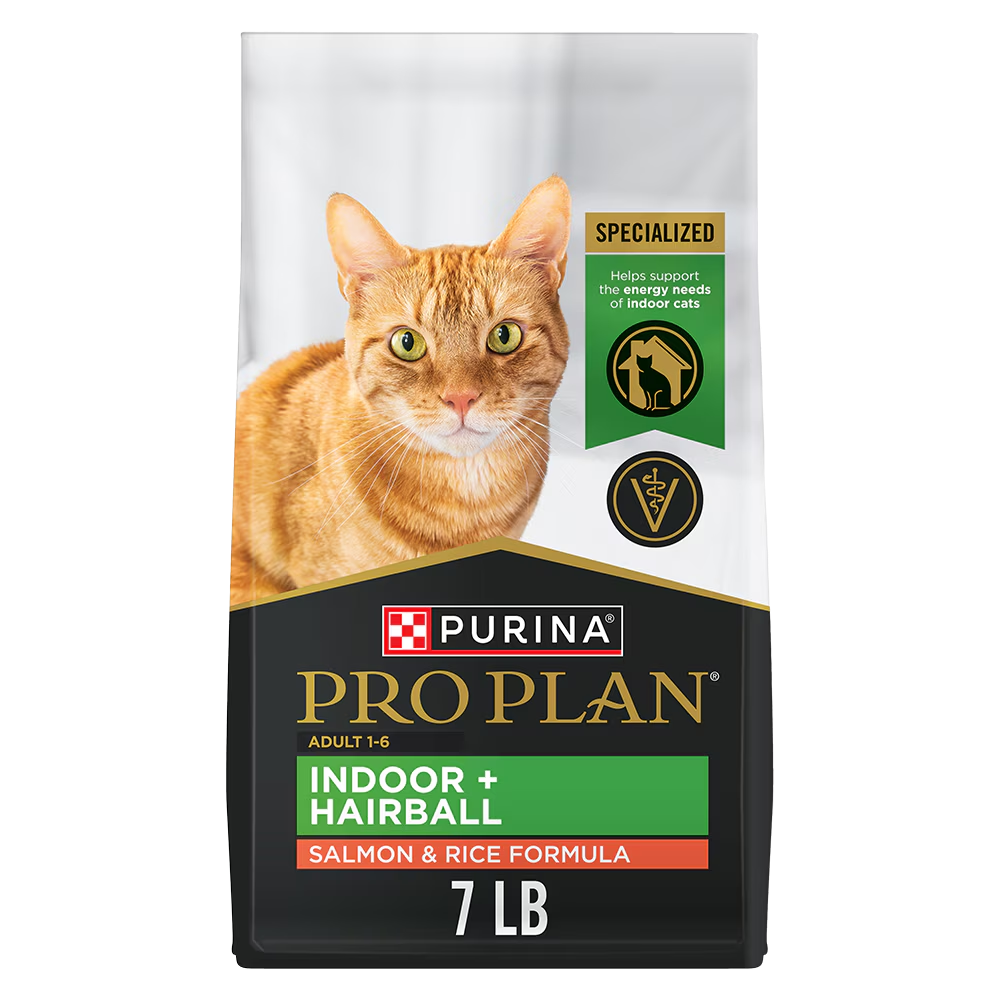
- Calories: about 3,926–3,979 kcal/kg, 445–451 kcal/cup (Salmon & Rice and Turkey & Rice).
- Why it stands out: Real turkey or salmon first, added fiber for hairballs, and a label stating that AAFCO feeding tests substantiate it — an extra layer of validation. Purina meets the full slate of WSAVA manufacturer criteria.
- Best for: Active indoor cats, cats losing muscle, and owners who weigh food in grams.
- Watch-outs: It’s calorie-dense per cup. This is the food where the 40% calorie trap bites hardest — measure carefully.
3. Best for litter-box odor and picky eaters: Royal Canin Indoor Adult
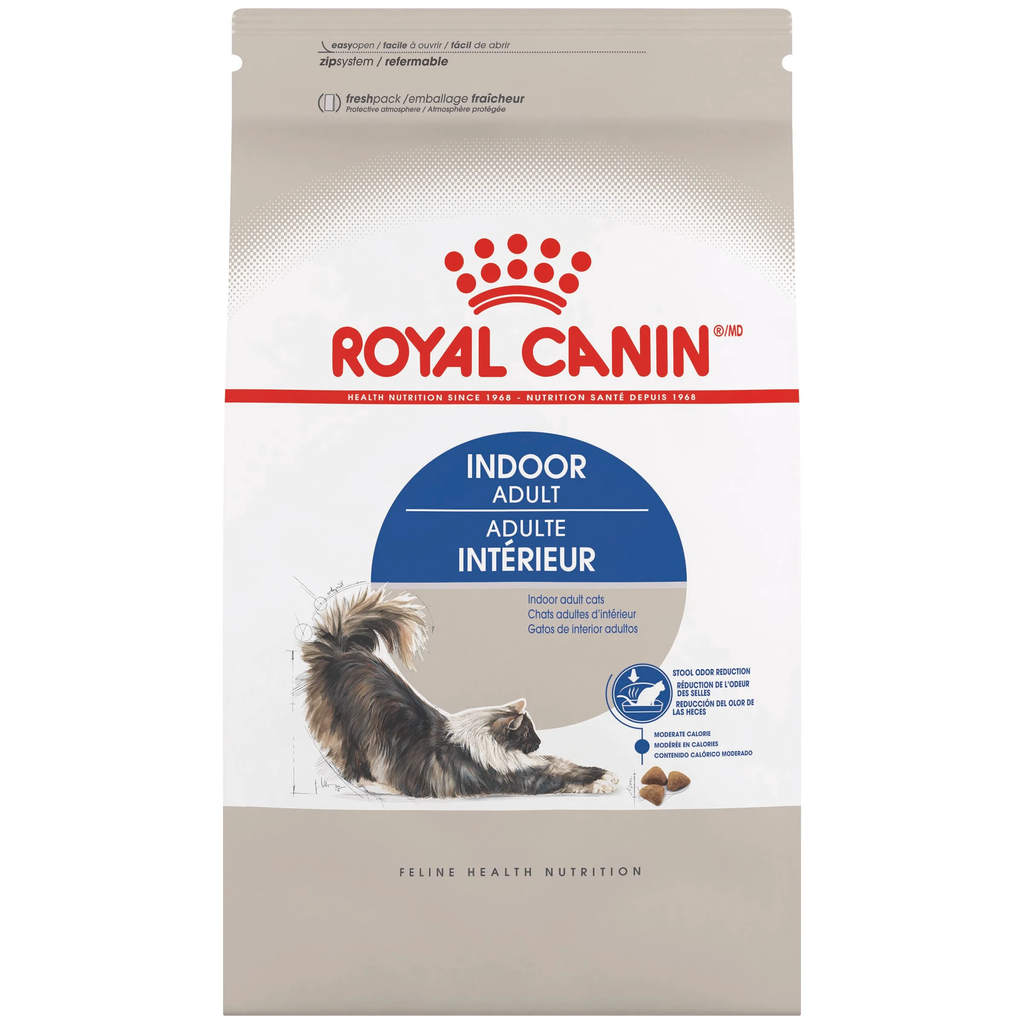
- Calories: about 3,533 kcal/kg, 344 kcal/cup.
- Why it stands out: Made for indoor cats aged 1–7, with highly digestible protein and a fiber blend aimed at reducing stool volume and odor — a real quality-of-life factor in small apartments. Royal Canin is known for palatability.
- Best for: Fussy eaters, small spaces, and cats with soft or smelly stools.
- Watch-outs: Protein is moderate compared with high-protein formulas (a guaranteed minimum of about 27% as fed in listings we checked).
4. Best for overweight indoor cats (no prescription): Royal Canin Weight Care or Hill’s Science Diet Adult Perfect Weight
- Why: These are built specifically for weight control, not just “indoor living.” Royal Canin Weight Care’s listed calorie density (about 3,227 kcal/kg in a Canadian listing) sits under the regulatory “light” ceiling.
- Best for: Cats with a body condition score of 6–7 out of 9 who need to lose a modest amount.
- Watch-outs: For cats that are obese (8–9 out of 9), ask your vet about therapeutic weight-loss diets, which deliver full nutrition at much lower calorie levels. Never crash-diet a cat (see the weight-loss section below).
5. Best for indoor senior cats: Hill’s Science Diet Adult 7+ Indoor (and 11+ Indoor)
- Calories: 7+ Indoor about 3,574 kcal/kg, 324 kcal/cup; 11+ Indoor about 3,790 kcal/kg, 398 kcal/cup.
- Why it stands out: The 7+ formula is supported by AAFCO feeding tests and tailored to aging indoor cats. Notice the 11+ formula is more calorie-dense — that’s intentional, because many cats over 12 struggle to hold weight rather than lose it.
- Best for: Middle-aged and senior indoor cats. Not sure which stage your cat is in? Use our Cat Age Calculator.
- Watch-outs: Senior cats need regular bloodwork, since kidney changes are common. If your vet finds early kidney disease, read our guide to cat food for kidney disease.
6. Best budget indoor dry foods: Purina ONE Indoor Advantage and IAMS ProActive Health Indoor Weight & Hairball Care
- Why: Both come from large manufacturers with research programs and offer complete-and-balanced indoor nutrition at a lower price.
- Best for: Multi-cat households and tight budgets.
- Watch-outs: Check the current calorie statement on the bag before portioning — we did not include these in our calorie table because listings varied.
7. Best wet food for indoor cats: any complete-and-balanced adult wet food from a research-backed brand
- Why: Wet food doesn’t need an “indoor” label to do the indoor job — its water content already lowers calorie density and boosts fullness. Hill’s, Royal Canin, and Purina Pro Plan wet lines are dependable, and Fancy Feast Classic Pâté is a budget option many vets are comfortable with.
- Best for: Every indoor cat, especially those prone to urinary issues or weight gain.
- Watch-outs: Some “gourmet” or broth-style products are supplemental, not complete — read the label. Rotate proteins rather than feeding fish every day; see can cats eat tuna and can cats eat salmon for why.
8. Best for urinary-prone indoor cats: a wet-forward diet, plus a vet-prescribed urinary food if needed
- Why: For cats with a history of crystals, stones, or cystitis, more water is the foundation, and therapeutic urinary diets can dissolve or help prevent certain stones.
- Best for: Cats with past urinary episodes, especially males.
- Read next: Our complete guide to cat food for urinary health.
What about premium and boutique brands?
Brands like Wellness, Tiki Cat, Weruva, and Instinct make high-protein, high-moisture foods that many owners love. Several don’t publicly document every WSAVA criterion (such as employing a full-time board-certified nutritionist or owning their plants). That doesn’t make them bad; it means you should ask the company those questions directly if manufacturer transparency matters to you.
Quick comparison
| Need | Our pick | Format | Key reason |
|---|---|---|---|
| Overall | Hill’s Science Diet Adult Indoor | Dry | Lowest kcal per cup among mainstream indoor formulas checked |
| High protein + hairballs | Purina Pro Plan Adult Indoor + Hairball | Dry | Meat first; feeding-trial substantiated |
| Odor + picky eaters | Royal Canin Indoor Adult | Dry | Highly digestible; stool-odor focus |
| Weight loss (non-Rx) | Royal Canin Weight Care / Hill’s Perfect Weight | Dry | Purpose-built for weight control |
| Seniors | Hill’s Science Diet Adult 7+ / 11+ Indoor | Dry | Life-stage tailored |
| Budget | Purina ONE Indoor Advantage / IAMS Indoor Weight & Hairball | Dry | Research-backed at lower cost |
| Hydration | Complete-and-balanced adult wet food | Wet | Water content does the “indoor” job |
| Urinary history | Wet-forward diet + vet urinary diet | Wet/Rx | Dilutes urine; targets stones |
How Much to Feed an Indoor Cat (Calories, Not Cups)
The best cat food for indoor cats can still cause weight gain if portions are off. Here’s the same method veterinary teams use, explained in full in our complete portion guide.
Step 1 — Use ideal weight, not current weight. If your cat is overweight, ask your vet for a target weight.
Step 2 — Calculate Resting Energy Requirement (RER): RER = 70 × (ideal body weight in kg)^0.75. A 10-lb (4.5 kg) cat has an RER of about 218 kcal.
Step 3 — Apply an indoor multiplier: about 1.0 × RER for strictly indoor, sedentary cats and about 1.2 × RER for a typical neutered indoor adult with some play. A handy shortcut for weight-prone indoor cats is about 20 kcal per pound of ideal body weight.
Step 4 — Divide by your food’s calories. Daily kcal ÷ kcal per cup (or per gram, or per can) = daily portion.
Indoor cat feeding chart (starting estimates)
| Ideal weight | Strictly indoor (≈1.0 × RER) | Typical neutered indoor (≈1.2 × RER) | Dry at 319 kcal/cup* | Dry at 451 kcal/cup* | Wet at 90 kcal per 3-oz can* |
|---|---|---|---|---|---|
| 6 lb (2.7 kg) | ~150 kcal | ~180 kcal | ~0.47 cup | ~0.33 cup | ~1.7 cans |
| 8 lb (3.6 kg) | ~185 kcal | ~220 kcal | ~0.58 cup | ~0.41 cup | ~2.1 cans |
| 10 lb (4.5 kg) | ~218 kcal | ~260 kcal | ~0.68 cup | ~0.48 cup | ~2.4 cans |
| 12 lb (5.4 kg) | ~250 kcal | ~300 kcal | ~0.78 cup | ~0.55 cup | ~2.8 cans |
| 14 lb (6.4 kg) | ~280 kcal | ~335 kcal | ~0.88 cup | ~0.62 cup | ~3.1 cans |
*Portions calculated at the “strictly indoor” calorie level. Individual cats can vary widely from formula estimates, so treat this as a starting point and adjust every 2–4 weeks based on weight and body condition. For a personalized number, use the free Cat Food Calculator.
A sample day for a 10-lb indoor cat (about 220 kcal)
| Time | What to feed | Approximate kcal |
|---|---|---|
| 7:00 a.m. | 1 × 3-oz can of complete-and-balanced wet food | 90 |
| Midday | About 20 g dry food in a puzzle feeder | 70 |
| 6:30 p.m. | 10 minutes of wand-toy play, then ½ can of wet food | 45 |
| Evening | A few treats or freeze-dried meat pieces | ≤15 |
| Total | ≈220 |
The 10% treat rule
Treats should stay under 10% of daily calories — for a 220-kcal cat, that’s only about 22 kcal. Plain cooked chicken, egg, or a little fish can work as treats; check our guides to chicken, eggs, and turkey, or look up any food in seconds with the CatFoodCheck Food Checker. And skip the saucer of milk — here’s why most adult cats shouldn’t drink cow’s milk.
Feeding Routines That Prevent Indoor Cat Weight Gain
Food choice and portion size matter, but routine is where most indoor cats win or lose the weight battle.
Switch from free-feeding to measured meals. A bowl that’s always full is the classic path to obesity. Measure the full day’s allowance each morning, split it into two to four meals, and when it’s gone, it’s gone. Kittens are the exception — they need frequent meals to grow.
Make cats work for food. Puzzle feeders, treat balls, and scattering kibble across a room tap into natural hunting behavior, slow fast eaters, and reduce boredom. Start with easy puzzles so your cat doesn’t give up.
Play, then feed. Cats naturally follow a hunt-catch-eat-groom-sleep rhythm. Ten minutes of wand-toy play right before a meal burns calories, relieves stress, and makes the meal feel like a reward.
Use technology wisely. Timed feeders help cats who wake you at 4 a.m. In multi-cat homes, microchip-activated feeders stop the food thief from eating everyone’s portion — and let you feed a weight-loss diet to one cat and a regular diet to another.
Weigh monthly and score body condition. Vets use a 1–9 body condition scale, where 4–5 is ideal. You should be able to feel ribs under a thin fat layer, see a waist from above, and see a slight belly tuck from the side. The WSAVA body condition charts are a free visual reference.
Lose weight slowly. Aim for roughly 1–2% of body weight per week, under veterinary guidance. Never crash-diet a cat or let an overweight cat go without eating — rapid fat mobilization can trigger hepatic lipidosis (fatty liver disease), a life-threatening condition.
Hairballs in Indoor Cats: What Food Can (and Can’t) Do
Indoor cats spend a lot of time grooming, and many owners notice shedding happens year-round. Swallowed hair normally passes through the gut, but some forms clumps that come back up.
What helps:
- Hairball-control formulas use fiber blends (such as cellulose, beet pulp, or psyllium) to help hair move through the digestive tract.
- Omega fatty acids support skin and coat health, which can mean less loose fur.
- Moisture from wet food supports healthy digestion and stool quality.
- A spoonful of plain pumpkin can add fiber for some cats — see our guide on whether cats can eat pumpkin for safe amounts.
- Brushing is the most underrated hairball remedy. Every hair in the brush is a hair your cat doesn’t swallow.
- Cat grass (oat or wheat grass grown for cats) gives indoor cats a safe outlet for the urge to chew plants.
What food can’t fix: Frequent hairballs aren’t simply “normal cat behavior.” Vomiting often, retching without producing anything, constipation, or appetite loss can signal gastrointestinal disease or, rarely, a blockage. Those need a vet, not a different bag of food.
A critical indoor warning about plants: Cats who chew houseplants can be poisoned. The FDA warns that true lilies and daylilies are extremely dangerous to cats — every part of the plant, including pollen and vase water, can cause kidney failure. Don’t keep them in a home with cats.
Urinary Health: Why Indoor Cats Need More Water
Lower urinary tract problems — cystitis, crystals, stones, and urethral blockages — have been associated with indoor living for decades. Several risk factors tend to cluster in indoor cats: low water intake, mostly-dry diets, excess weight, inactivity, and stress.
Practical ways to raise water intake:
- Make wet food a daily part of the diet.
- Add a little warm water to wet food, or soak a portion of kibble.
- Offer several water stations away from food bowls and litter boxes; many cats prefer wide, shallow bowls.
- Try a water fountain — some cats drink more from moving water.
- As a rough rule of thumb, a cat’s daily water need in milliliters is similar to their daily calorie need in kcal, and wet food covers much of it.
Reduce stress: Enrichment — vertical space, hiding spots, window perches, play, and predictable routines — is part of the evidence-based management of feline idiopathic cystitis, not just a nice extra.
Emergency warning: A cat — especially a male — who strains in the litter box and produces little or no urine may have a urethral blockage. This is a life-threatening emergency. Go to a vet immediately.
For a detailed breakdown of urinary nutrients, target urine pH, and therapeutic diets, read Cat Food for Urinary Health: What to Look For.
Indoor Cat Food by Life Stage
Indoor kittens (up to about 12 months)
Kittens need food labeled for “growth” or “all life stages,” with more calories, protein, fat, and DHA than adult food. Don’t restrict a healthy kitten’s food the way you would an adult’s. One key indoor tip: energy needs drop noticeably after spaying or neutering, so ask your vet how to adjust portions after surgery — this is when many indoor cats start gaining weight. Most cats switch to adult food around 10–12 months; large breeds may mature later.
Indoor adults (about 1–7 years)
This is the stage most “indoor” formulas target. Focus on a complete-and-balanced adult food, measured portions, wet-forward feeding, and daily play.
Indoor seniors (7+ and 11+)
Many cats aged 7–11 slow down and need slightly fewer calories. But after about 12, many cats digest and absorb nutrients less efficiently and need more calories and highly digestible protein to maintain muscle. Unexplained weight loss in an older cat is a red flag worth a vet visit, as are increased thirst and urination, which can signal kidney disease, diabetes, or hyperthyroidism. Pregnant or nursing indoor cats need growth or all-life-stages food; you can track her timeline with our Cat Pregnancy Calculator.
Food Safety for Indoor Cats: Risks That Come Through the Door
Indoor living keeps many dangers out, but food is one way risks still get in.
Raw diets
The CDC does not recommend feeding raw pet food or treats to cats or dogs, because raw products can carry germs like Salmonella and Listeria that sicken pets and people. Cats face an added threat: the FDA has warned that cats have been infected with H5N1 avian influenza through raw pet food and raw milk, and in 2025 it alerted pet owners about specific lots of a frozen raw cat food after an infected cat in San Francisco had to be euthanized. You can follow current alerts on the FDA’s outbreaks and advisories page. If you’re still considering raw feeding, read our balanced raw cat food diet guide first.
Human foods
Indoor cats share space with our kitchens. Onion and garlic are toxic in every form, chocolate is dangerous in any amount, and many “treats” are just extra calories. Keep our complete list of foods toxic to cats handy, along with our guides on garlic, onion, and chocolate. In multi-pet homes, keep cats out of the dog’s bowl — here’s why dog food can’t replace cat food.
Recalls and reporting problems
Check the FDA’s recalls and withdrawals list whenever you switch foods. If you suspect a food made your cat sick, stop feeding it, call your vet, keep the original packaging (it holds lot numbers and production dates), and report the problem to the FDA.
Indoor Cat Food Myths, Quickly Busted
“Indoor cats need grain-free food.” Not for most cats. Grains aren’t inherently harmful, and what matters far more is total protein, calories, and completeness. See Grain-Free Cat Food: Is It Actually Better? and can cats eat rice.
“Indoor food is diet food.” As our calorie table shows, popular indoor formulas don’t meet the regulatory definition of “light.”
“Natural” or “holistic” means healthier. “Natural” has an industry definition about ingredient sourcing and processing, not health outcomes. “Holistic” and “premium” have no regulatory meaning at all.
“A seal or endorsement means it’s balanced.” The FDA specifically notes that endorsements and seals of approval aren’t assurances of nutritional adequacy. The AAFCO statement is what counts.
“My cat will stop eating when full.” Many indoor cats, especially neutered ones, will happily overeat when food is always available.
How to Switch Your Indoor Cat to a New Food
Cats are creatures of habit with sensitive stomachs. Transition over 7–10 days (longer for sensitive cats):
| Days | Old food | New food |
|---|---|---|
| 1–2 | 75% | 25% |
| 3–4 | 50% | 50% |
| 5–6 | 25% | 75% |
| 7+ | 0% | 100% |
Don’t forget to recalculate portions using the new food’s calorie statement — this is exactly when the 40% calorie trap happens. And never try to “starve out” a picky cat. If your cat refuses food for more than a day, call your vet.
10 Common Indoor Cat Feeding Mistakes
- Buying “indoor” food and assuming portions take care of themselves.
- Scooping by volume instead of weighing in grams.
- Keeping the same scoop size after switching brands.
- Free-feeding dry food all day.
- Feeding a full wet portion and a full dry portion, which effectively doubles calories.
- Uncounted treats, table scraps, and milk.
- Feeding to current (overweight) weight instead of ideal weight.
- Ignoring water intake on an all-dry diet.
- Crash-dieting an overweight cat.
- Never re-checking portions as your cat ages or becomes less active.
Printable Indoor Cat Food Shopping Checklist
- [ ] “Complete and balanced” for adult maintenance or all life stages
- [ ] Named animal protein near the top of the ingredient list
- [ ] Calorie statement noted (kcal/kg and kcal/cup or kcal/can)
- [ ] Calorie density appropriate for my cat’s weight goal
- [ ] Wet food included in the daily plan
- [ ] Fiber and omega fatty acids if hairballs are an issue
- [ ] Manufacturer can answer the WSAVA questions
- [ ] Not on the FDA recall list
- [ ] Daily portion calculated with the Cat Food Calculator
- [ ] Kitchen scale ready
When to Talk to Your Veterinarian
See your vet before changing foods, or soon after, if your indoor cat:
- Is gaining or losing weight without a change in feeding
- Drinks or urinates more than usual
- Strains in the litter box or produces little urine (emergency for males)
- Vomits often, has frequent hairballs, or retches without producing anything
- Stops eating for more than a day
- Is a kitten, senior, pregnant, nursing, or has a chronic condition
Your veterinary team can assign an accurate body condition score, set a target weight, run bloodwork, and recommend therapeutic diets when needed.
Frequently Asked Questions
What is the best cat food for indoor cats? The best cat food for indoor cats is a complete-and-balanced adult food from a research-backed manufacturer, rich in animal protein, with a moderate calorie density you portion carefully, ideally combined with wet food. Hill’s Science Diet Adult Indoor, Purina Pro Plan Adult Indoor + Hairball, and Royal Canin Indoor Adult are strong starting points.
Do indoor cats really need “indoor” cat food? Not necessarily. “Indoor” isn’t a regulated term. Indoor formulas are often somewhat lower in calories and higher in fiber, which can help, but any complete-and-balanced adult food can work if you portion it correctly for your cat’s calorie needs.
Is wet or dry food better for indoor cats? Many veterinarians favor a wet-forward diet for indoor cats because wet food adds water, supports urinary health, and helps cats feel full on fewer calories. Dry food is convenient and works well in puzzle feeders. A measured mix often gives the best of both.
How many calories does an indoor cat need per day? Most spayed or neutered indoor adult cats need roughly 150–300 kcal per day. A 10-lb indoor cat typically needs about 200–260 kcal, with sedentary cats at the lower end. Calculate your cat’s number from ideal weight using the CatFoodCheck Cat Food Calculator.
Is indoor cat food the same as weight-control cat food? No. Only foods labeled “light,” “lite,” or “low calorie” must meet calorie limits — 3,250 kcal/kg or less for dry cat food. The indoor formulas we checked didn’t meet that threshold. Overweight cats may need a weight-control or veterinary therapeutic diet.
What should I feed an indoor cat that gains weight easily? Feed measured meals based on ideal weight, make wet food the core of the diet, use puzzle feeders, and limit treats to 10% of calories. A higher-protein, lower-calorie food helps. If your cat is already overweight, ask your vet about a weight-loss plan.
What’s the best food for indoor cats with hairballs? Choose a complete-and-balanced hairball or indoor formula with added fiber and omega fatty acids, add wet food for moisture, and brush your cat regularly. Frequent hairballs, retching, or constipation should be checked by a veterinarian.
Is grain-free food better for indoor cats? For most indoor cats, no. Grain-free food isn’t automatically lower in carbohydrates or calories. Protein quality, calorie density, and a complete-and-balanced statement matter far more than whether a food contains grains.
Is raw food safe for indoor cats? The CDC does not recommend raw pet food because of bacteria like Salmonella and Listeria, and the FDA has warned that cats have contracted H5N1 bird flu from raw pet food and raw milk. Cooked, complete-and-balanced commercial food is the safer choice.
How often should I feed my indoor cat? Most adult indoor cats do well with two to four measured meals a day, using the same total daily calories. Kittens need three to four meals. Puzzle feeders or timed feeders can spread portions across the day.
When should an indoor kitten switch to adult food? Most kittens switch to adult food around 10–12 months, though large breeds such as Maine Coons may need growth food longer. Energy needs drop after spaying or neutering, so review portions with your vet after surgery.
Can I feed my indoor cat regular adult cat food? Yes, as long as it’s complete and balanced for adult maintenance and you portion it to your cat’s calorie needs. Standard adult foods are often more calorie-dense than indoor formulas, so portions will usually be smaller.
The Bottom Line
The best cat food for indoor cats isn’t defined by the word “indoor” on the bag. It’s a complete-and-balanced adult food from a company that invests in nutrition science, built on animal protein, fed in measured portions, and paired with plenty of moisture. Choose a solid formula from the picks above, calculate your cat’s calories, weigh food in grams, make wet food a daily habit, and turn mealtimes into a little hunt. Then let your cat’s weight and body condition — checked every few weeks — tell you whether to adjust.
Your next step: Plug your cat’s ideal weight into the free CatFoodCheck Cat Food Calculator to get an exact daily portion for wet, dry, or mixed feeding. And if you want our weekly safety guides, grab the free toxic foods checklist.
Sources and Further Reading
U.S. government and public-sector sources
- U.S. Food and Drug Administration — “Complete and Balanced” Pet Food
- U.S. Food and Drug Administration — FDA’s Regulation of Pet Food
- U.S. Food and Drug Administration — Pet Food Recalls and Withdrawals
- U.S. Food and Drug Administration — How to Report a Pet Food Complaint
- U.S. Food and Drug Administration — Outbreaks and Advisories (Center for Veterinary Medicine)
- U.S. Food and Drug Administration — Lovely Lilies and Curious Cats: A Dangerous Combination
- Centers for Disease Control and Prevention — About Pet Food Safety
- North Dakota Administrative Code 7-17-10 — Pet Food Descriptive Terms (“light,” “lean,” carbohydrate claims)
- National Library of Medicine (PubMed) — Slingerland et al., 2009: Indoor confinement and physical inactivity as diabetes risk factors in cats
- National Library of Medicine (PubMed) — Öhlund et al., 2017: Environmental risk factors for diabetes mellitus in cats
- National Research Council of the National Academies — Nutrient Requirements of Dogs and Cats (report sponsored in part by NIH and FDA)
Veterinary and professional organizations
- World Small Animal Veterinary Association — Global Nutrition Guidelines and body condition charts
- Association of American Feed Control Officials — AAFCO
- Association for Pet Obesity Prevention — Cat Body Condition Scoring
- Cornell Feline Health Center — Feeding Your Cat
- Buffington, C.A.T. (2002). External and internal influences on disease risk in cats. Journal of the American Veterinary Medical Association, 220(7), 994–1002.
Product data: Calorie figures were taken from manufacturer and retailer product listings for Hill’s Science Diet, Purina Pro Plan, and Royal Canin, checked October 1, 2026. Formulas and values can change and may differ by country.
Related Guides on CatFoodCheck
- How Much Should I Feed My Cat? A Complete Portion Guide by Weight
- Best Wet Cat Food Brands Ranked by Vets (2026)
- Cat Food for Urinary Health: What to Look For
- Cat Food for Kidney Disease: Vet-Recommended Options
- Cat Food Ingredients to Avoid: The Complete Label Reading Guide
- Grain-Free Cat Food: Is It Actually Better?
- Raw Cat Food Diet: The Complete Beginner’s Guide
- Foods That Are Toxic to Cats — The Complete List
- Cat Food Calculator · Cat Age Calculator · All Cat Nutrition Guides
Disclaimer: This article is for general educational purposes and is not a substitute for professional veterinary advice. Calorie targets are starting estimates, and individual cats vary. Always consult your veterinarian before making significant changes to your cat’s diet, especially for kittens, seniors, pregnant or nursing cats, or cats with a medical condition. Therapeutic diets require veterinary authorization. Product formulas and calorie values change over time — confirm the current label before purchasing.