That’s the short version. The rest of this guide covers what most “25-50-75” charts leave out: how to keep calories right when the new food is richer or lighter, what to do if diarrhea starts halfway through, how to win over a cat that refuses the new food, and the special rules for dry-to-wet, prescription diets and emergency switches.
Key takeaways
- Go slow: 7–10 days is the standard. The American Animal Hospital Association notes that some cats need up to 40 days, especially cats that are used to one texture.
- Match calories, not cups: foods differ a lot in calories per cup or can. Swapping cup-for-cup can quietly underfeed or overfeed your cat.
- Soft stool can be normal; watery stool isn’t. Mild softening is common during a switch. Watery diarrhea, repeated vomiting or a cat that stops eating means you should stop and call your vet.
- Never starve a cat into eating a new food. Cats that go without food for a few days can develop a life-threatening liver disease called hepatic lipidosis.
- Don’t introduce a new long-term food while your cat is sick or nauseous. Cats can learn to hate a food they ate while feeling ill.
Why Changing Cat Food Too Fast Upsets the Stomach
Your cat’s digestive system is tuned to the food they eat every day. The gut bacteria and digestive enzymes have adapted to that food’s protein sources, fat level, fiber and moisture. When you change everything overnight, the gut has to cope with a different mix of nutrients all at once. The usual result is soft stool, diarrhea, gas, vomiting or a temporary loss of appetite.
Veterinary nutritionists at Tufts University explain that a slow change gives the digestive tract time to adjust, and they recommend allowing at least a week. Some pets switch in a day with no trouble; others need 4 to 6 weeks.
Changing too fast causes two different problems, and it helps to know which one you’re facing:
- Stomach upset: your cat eats the new food, but their gut reacts with soft stool, diarrhea, vomiting or gas. The fix is usually to slow down.
- Food refusal: your cat won’t eat the new food at all, or eats less of everything. Cats are creatures of habit, and many are suspicious of unfamiliar smells and textures. The fix is a different method (see the side-by-side method below), not just more time.
Food refusal is the more dangerous of the two. A cat that stops eating can become seriously ill (more on that in the red-flags section below).
Before You Switch: 5 Checks That Prevent Problems
Most transition problems start before the first mixed meal. Run through these five checks first.
1. Make sure the new food is complete and balanced for your cat’s life stage
Look for the nutritional adequacy statement on the label. The Association of American Feed Control Officials (AAFCO) calls it “perhaps the most important part of a label”. It should say the food is “complete and balanced” for your cat’s life stage: growth (kittens), maintenance (adults) or all life stages. Foods labeled for “intermittent or supplemental feeding,” and toppers, are not meant to be a full diet.
The World Small Animal Veterinary Association (WSAVA) also suggests a few questions to ask any pet food brand: who formulates the food, what quality control they do, and whether calorie content is listed. If you’re still choosing, our guides to the best wet cat food brands, cat food ingredients to avoid and whether grain-free cat food is better can help you narrow it down.
2. Compare calories, not just portion size
This is the step most owners skip, and it causes slow weight gain or loss that’s easy to blame on the “new food.” Every complete cat food lists a calorie content statement in kcal per kilogram, plus kcal per cup or per can.
Here’s how much difference it makes:
| Old food | New food | |
|---|---|---|
| Calories | 400 kcal per cup | 350 kcal per cup |
| Your cat needs | 220 kcal/day | 220 kcal/day |
| Correct daily amount | ~0.55 cup | ~0.63 cup |
| If you swap cup-for-cup | — | 0.55 cup = 192 kcal (about 13% less) |
Tufts’ veterinary nutritionists make the same point: equal volumes of different foods don’t give equal calories, so weighing food in grams is the most accurate method. Use our cat food calculator to work out your cat’s daily calories and portions for the new food. For the bigger picture, see how much you should feed your cat.
3. Pick a calm time
Don’t start a food change during a stressful week: moving house, boarding, a new pet or baby, or recovery from surgery. Stress alone can upset a cat’s stomach, and you won’t know whether the food or the stress is to blame.
Never introduce a new long-term food while your cat is nauseous or unwell. The American Animal Hospital Association (AAHA) warns that cats can develop a learned food aversion when they eat a food shortly before feeling sick, and that aversion can last up to 40 days. If your vet has prescribed a new diet for an illness, ask whether to start it now or once the nausea is under control.
4. Buy enough of both foods
You’ll need at least 2 weeks of the old food to finish the switch, and more if your cat turns out to be a slow adjuster. Running out halfway forces the abrupt change you were trying to avoid.
5. Talk to your vet first if your cat has a health condition
Cats with kidney disease, diabetes, urinary problems, food allergies, inflammatory bowel disease or a history of pancreatitis may need a specific food or a specific transition plan. Your vet may even want a faster switch for a medical reason. Don’t change a prescription diet without asking.
The Standard 7–10 Day Cat Food Transition Schedule
This schedule works for most healthy adult cats switching between foods of the same type, for example one dry food to another.
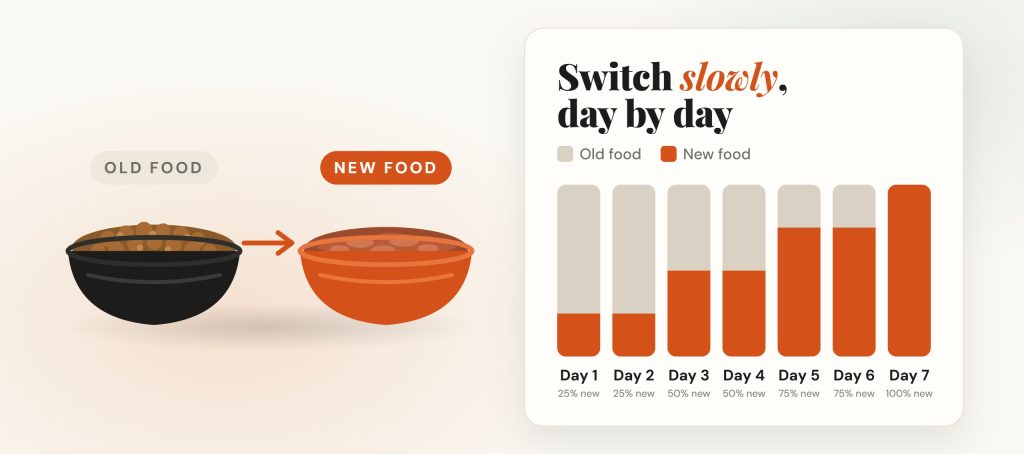
7-day schedule
| Day | Old food | New food |
|---|---|---|
| Days 1–2 | 75% | 25% |
| Days 3–4 | 50% | 50% |
| Days 5–6 | 25% | 75% |
| Day 7 onward | 0% | 100% |
10-day schedule (a little gentler)
| Day | Old food | New food |
|---|---|---|
| Days 1–3 | 75% | 25% |
| Days 4–6 | 50% | 50% |
| Days 7–9 | 25% | 75% |
| Day 10 onward | 0% | 100% |
How to use the percentages: apply them to your cat’s daily calories, not to cups. Using the example above (220 kcal a day, old food 400 kcal/cup, new food 350 kcal/cup), the 7-day plan looks like this:
| Day | Old food (400 kcal/cup) | New food (350 kcal/cup) |
|---|---|---|
| Days 1–2 | about 6½ tbsp | about 2½ tbsp |
| Days 3–4 | about 4½ tbsp | about 5 tbsp |
| Days 5–6 | about 2 tbsp | about 7½ tbsp |
| Day 7+ | — | about 10 tbsp (⅝ cup) |
(1 cup = 16 tablespoons. Split the daily amount across your cat’s usual meals.)
Tips for the standard switch
- Mix thoroughly so your cat can’t pick out the old food. For dry food, shake both kibbles together in a container.
- Keep meal times and bowls the same. Change one thing at a time.
- Watch the litter box every day. Stool quality is your best early warning (see the poop chart below).
- Don’t rush when it’s going well. If your cat is fine on day 3, stick to the plan anyway. Problems often show up a day or two after a step up.
The Slow Schedule for Sensitive Stomachs (14 Days or Longer)
Use a slower plan if your cat has had diarrhea or vomiting with past food changes, is a senior, has a known sensitive stomach, or is moving to a very different food (for example, a much higher-fat or higher-fiber formula).
| Day | Old food | New food |
|---|---|---|
| Days 1–2 | 90% | 10% |
| Days 3–4 | 75% | 25% |
| Days 5–6 | 60% | 40% |
| Days 7–8 | 50% | 50% |
| Days 9–10 | 40% | 60% |
| Days 11–12 | 25% | 75% |
| Day 13 | 10% | 90% |
| Day 14 onward | 0% | 100% |
There’s no prize for finishing fast. AAHA’s guidance notes that cats may need up to 40 days to transition, and one to two months if they’re used to a particular texture. If any step causes soft stool, simply stay at the previous step for a few extra days before moving on.
The Side-by-Side Method for Picky Cats (No Mixing)
Some cats refuse a bowl the moment they detect anything unfamiliar in it, and then they won’t eat either food. For these cats, mixing backfires. The UK veterinary charity PDSA recommends keeping the two foods separate because texture matters so much to cats, and a feline-practice client handout hosted by the American Association of Feline Practitioners puts it even more bluntly: “DO NOT MIX FOODS.”
How to do it:
- Serve the usual meal in the usual bowl. Next to it, put a separate small dish with about a teaspoon of the new food.
- Let your cat explore. Sniffing or licking the new food is progress, not failure.
- Remove uneaten new food after about an hour and offer a fresh teaspoon at the next meal. Tufts suggests this approach for cats; a new food can take several tries before it feels familiar.
- Once your cat has eaten the new food happily for about 3 days in a row, start increasing the new food and reducing the old food in steps of about 25%.
- When your cat has eaten both foods consistently for about a week, switch to the new food only.
This method usually takes 2 weeks or more. The catvets.com handout notes that some cats need up to 3 months. That’s fine, as long as your cat is eating enough calories in total every day.
If your cat still won’t touch the new food after a few weeks, PDSA suggests trying a different flavor, texture or brand rather than forcing the issue.
Is It Normal? What Your Cat’s Poop Is Telling You
Some soft stool during a food change is normal, according to Tufts’ veterinary nutritionists. Vets often use a 1–7 fecal scoring chart to describe stool. The version below follows the Purina fecal scoring chart used by Ohio State’s veterinary hospital, with what to do at each score during a transition.
| Score | What it looks like | What to do during a food switch |
|---|---|---|
| 1 | Very hard, dry pellets; hard to pass | Too dry. Check your cat is drinking; adding wet food often helps. Call your vet if your cat strains or seems uncomfortable. |
| 2 | Firm, segmented log; leaves little residue | Ideal. Carry on with the schedule. |
| 3 | Log-shaped, moist surface, holds its shape | Fine. Carry on, but don’t speed up. |
| 4 | Very moist and soggy; loses shape when picked up | Pause. Stay at the current ratio for 2–3 days before the next step. |
| 5 | Very moist piles rather than logs | Step back to the last ratio that gave normal stool. |
| 6 | Soft piles or spots with no defined shape | Step back to the last good ratio. If it doesn’t improve within a day or two, call your vet. |
| 7 | Watery puddles, no texture | Stop increasing the new food and call your vet, sooner for kittens, seniors and cats with health problems. |
Also watch for:
- Vomiting: one hairball-type vomit isn’t unusual; repeated vomiting is not normal.
- Gas or a gurgling stomach: usually mild and temporary; slow down if it continues.
- Constipation: can happen when moving to a drier or lower-fiber food. Encourage drinking and consider adding wet food.
- Eating less: a sign your cat may dislike the new food (see the picky-eater tips below).
What to Do If Your Cat Gets Diarrhea or Vomits During the Switch
If your cat has mild signs (soft stool, a little gurgling) but is otherwise bright, eating and drinking normally:
- Go back one step. Tufts recommends staying at the last ratio that didn’t cause problems for a day or two before continuing. Many cats need 2–3 days.
- Make smaller steps. Move up by 10% at a time instead of 25%.
- Feed smaller, more frequent meals. Splitting the day’s food into 3–4 small meals is easier on the gut than 1–2 big ones.
- Make sure fresh water is always available. Diarrhea causes fluid loss. A water fountain or extra bowls in different rooms can encourage drinking.
- Don’t add several new things at once. Treats, toppers, supplements and table scraps all make it harder to tell what’s causing the upset.
How long should diarrhea last? PDSA says diarrhea caused by a sudden food change usually settles within 1–3 days. If it lasts longer than 2–3 days, contains blood or mucus, or your cat seems unwell, it’s time for a vet visit.
What about a bland diet? For a cat that’s otherwise well, PDSA suggests a short-term bland diet such as plain boiled chicken (no skin, bones or seasoning) or a little plain white rice, or a bland diet supplied by your vet, then reintroducing the normal food slowly once stools are firm. See our guides on whether cats can eat chicken and whether cats can eat rice. A bland diet is not complete and balanced, so keep it to a day or two unless your vet advises otherwise.
Does pumpkin help? Plain canned pumpkin is a popular home remedy, but Tufts’ veterinary nutritionists point out that it’s a surprisingly weak source of fiber: a cat would need more than 2½ cups a day to match the fiber in a high-fiber therapeutic diet. Never use pumpkin pie filling, which contains sugar and spices. If your cat needs extra fiber, ask your vet to recommend a proper fiber supplement or diet. Our guide to whether cats can eat pumpkin covers safe amounts.
What about probiotics? PDSA notes that probiotics may help some pets but not all. If you want to try one, ask your vet for a product made for cats with good quality control.
Troubleshooting table
| Problem | Likely cause | What to try |
|---|---|---|
| Soft stool after a step up | Step was too big or too fast | Go back one step for 2–3 days, then use 10% steps |
| Diarrhea from day 1 | Very different fat or fiber level, or a sensitive gut | Restart with the 14-day plan at 10% new food |
| Vomiting right after eating | Eating too fast, or too much at once | Smaller, more frequent meals; a slow-feeder or flat plate |
| Picks out the old food | Prefers the old food’s taste or texture | Mix more thoroughly, or switch to the side-by-side method |
| Eats less of everything | Dislikes the smell or texture in the mix | Use the side-by-side method; warm wet food slightly |
| Gaining or losing weight | Calories don’t match the old food | Recalculate portions with the cat food calculator |
| Upset continues even at 100% | The new food doesn’t suit your cat | Talk to your vet; you may need a different formula |
How to Switch from Dry to Wet Cat Food
Moving from kibble to wet food is one of the best changes you can make for many cats’ hydration, but it’s also one of the hardest, because it changes texture, smell and portion size all at once.
Why it’s a big change: canned cat food is at least 75% water, while dry food is only 6–10% water, according to the Cornell Feline Health Center. That means your cat needs a much larger volume of wet food to get the same calories. In our example, 220 kcal is about ½ cup of kibble but about 2½ three-ounce cans of a typical 85-kcal wet food.
How to do it:
- Start tiny. Offer a teaspoon of wet food alongside the usual kibble, or on top of it, at one meal a day.
- Warm it slightly. Cats prefer food at room temperature or close to body temperature. Researchers writing in the Encyclopedia of Feline Clinical Nutrition report that cats prefer food near 38–40°C (100–104°F), and that raising food temperature from 20°C to 40°C can increase intake by up to 80%, probably because warmth releases aroma. Warm wet food for a few seconds, stir well to remove hot spots, and test it with your finger.
- Try different textures. Pâté, minced, chunks in gravy and shreds feel very different to a cat. A cat that ignores pâté may love shreds, and the other way around.
- Use the gravy as a bridge. Some cats accept kibble with a little wet-food gravy drizzled on top before they’ll eat the wet food itself.
- Expect it to take longer. AAHA notes that cats used to one texture may need one to two months to switch.
- Don’t leave wet food out for hours. Remove leftovers after the meal and refrigerate opened cans, as Cornell recommends.
You don’t have to go 100% wet. Many owners settle on a mix of wet and dry, which is fine as long as the total calories are right. Our cat food calculator has a mixed-feeding option that splits the calories for you. Wet food is often recommended for cats prone to urinary problems; see our guide to cat food for urinary health, and our picks of the best wet cat food brands.
How to Switch from Wet to Dry Cat Food
Going the other way is usually easier for acceptance, since many cats like crunchy kibble, but there are two traps:
- Portion size shrinks. Dry food is far more calorie-dense, so the same “bowlful” holds many more calories. Measure carefully, ideally with a kitchen scale, or your cat will gain weight. Our guide to the best cat food for indoor cats explains why indoor cats are especially prone to this.
- Water intake drops. Your cat will need to drink more to make up for the moisture they used to get from wet food. Provide several water bowls or a fountain, and keep an eye on urination.
Don’t soak kibble in water to make it more familiar: the same nutrition encyclopedia notes that cats, unlike dogs, generally don’t appreciate rehydrated kibble. Use the standard 7–10 day schedule, applied to calories.
Switching to Raw, Fresh or Homemade Food
These are the biggest changes of all. They often differ from commercial kibble in fat, protein, moisture and fiber, so use the slow 14-day schedule as a minimum.
Two safety points matter more than the schedule:
- Raw food carries real infection risks. The U.S. Food and Drug Administration found raw pet foods were more often contaminated with Salmonella and Listeria than other pet foods it tested, and the bacteria can spread to people in the household. Read our full guide to the raw cat food diet before you switch.
- Homemade diets must be properly formulated. Recipes from the internet are often missing essential nutrients such as taurine. If you want to cook for your cat, use a recipe formulated by a board-certified veterinary nutritionist. Our homemade cat food recipes guide explains how to do it safely.
Switching from Kitten Food to Adult Food
Kittens need more calories and nutrients for growth. The AAHA/AAFP Feline Life Stage Guidelines define the kitten stage as birth to 1 year, so most cats move to an adult maintenance food around their first birthday. Ask your vet whether your cat’s breed, size or body condition changes the timing. (Not sure how old your cat is in human terms? Try our cat age calculator.)
Use the standard 7–10 day schedule, and recalculate portions: adult food usually has fewer calories, and an adult cat needs fewer calories per pound than a growing kitten.
Bringing home a new kitten or adopted cat? Don’t change their food straight away. PDSA advises keeping a newly homed kitten on the food they were already eating at first, then changing gradually later. Ask the breeder or shelter exactly what they fed, and wait until your cat has settled in (usually a week or two) before starting a transition.
Switching a Senior Cat’s Food
The same life-stage guidelines class cats as seniors from 10 years. Age alone isn’t a reason to change a healthy cat’s food. Switch when there’s a reason, such as weight loss, weight gain, dental problems, or a condition your vet has diagnosed.
Older cats are often more sensitive to change, so the 14-day schedule is a good default. If your senior cat starts eating less or losing weight, see your vet before assuming it’s the food: the Cornell Feline Health Center advises that any cat refusing food and losing weight should be examined. Our guide to why a cat isn’t eating covers the common causes.
Switching to a Prescription or Therapeutic Diet
Prescription diets for kidney disease, urinary crystals, diabetes, food allergies or digestive problems are medical treatment, so your vet’s instructions come first. A few general points:
- Ask your vet how fast to switch. Some conditions call for a quick change; others benefit from a slow one.
- Treat nausea first. Because of the learned-aversion risk described above, your vet may want to control nausea before introducing the new diet, so your cat doesn’t associate it with feeling sick.
- Kidney diets can be less tasty. Cats with kidney disease often need extra patience. Our guide to cat food for kidney disease covers what to look for and how to encourage eating.
- Food allergy trials need to be strict. An elimination diet trial usually lasts 8 to 12 weeks, with no other foods, treats or flavored medications, or the result won’t be reliable.
- Eating something is better than eating nothing. If your cat refuses a prescription diet for more than a day, call your vet. There are often several brands and textures of the same type of diet.
When You Have to Switch Cold Turkey
Sometimes a gradual switch isn’t possible: the old food has been recalled or discontinued, it’s out of stock, your vet has ordered an immediate change, or you’ve adopted a cat and don’t know what they were eating. You can check for pet food recalls on the FDA’s recalls page.
To reduce stomach upset when you have to switch suddenly:
- Choose a similar food. Stick to the same format (dry to dry, pâté to pâté) and look for a similar fat and fiber level in the guaranteed analysis. Same brand, same life stage is ideal.
- Feed smaller meals more often for the first few days, such as 4 small meals instead of 2.
- Keep everything else the same: bowls, location, meal times, no new treats.
- Watch the litter box closely and use the poop chart above.
- Ask your vet about a short-term digestive-care diet if your cat has a sensitive stomach.
In a true emergency (for example, you run out of cat food late at night), a single meal of plain cooked chicken or another complete cat food is better than skipping meals. Dog food is fine for one meal, but not long-term; see can cats eat dog food for why.
Switching Food in a Multi-Cat Household
- Feed cats separately during the transition, so each cat eats their own planned portion and you can see who has an upset stomach.
- If only one cat is changing diets (for example, onto a prescription food), feed them in a separate room or use a microchip feeder, so the other cats can’t eat it and vice versa.
- If all cats are switching to the same food, run the transition for everyone at the pace of the most sensitive cat.
How to Get a Picky Cat to Eat New Food
If your cat is suspicious of the new food, try these tricks before you give up on it:
- Warm wet food to around body temperature to boost its smell (stir well and test before serving).
- Stay within a texture family. If your cat loves pâté, start with a pâté version of the new brand.
- Use a tempting topper, but keep it small and safe. AAHA suggests a little canned food or low-salt tuna, clam or chicken broth as a flavor enhancer. Check broth labels carefully: many human broths and stocks contain onion or garlic, which are toxic to cats. See is garlic toxic to cats and our full list of foods toxic to cats. A teaspoon of the water from tuna canned in spring water also works; see can cats eat tuna for limits.
- Skip the milk. Most adult cats are lactose intolerant, so milk can cause the very diarrhea you’re trying to avoid. See can cats drink milk.
- Feed scheduled meals instead of free-feeding. A cat with a full bowl of old kibble available all day has little reason to try something new. Set meal times instead.
- Offer fresh food at every meal. Cats are sensitive to stale or rancid smells, so don’t top up yesterday’s food.
- Get the setting right. Cornell notes that heavy foot traffic, noise, other animals, dirty bowls and nearby litter boxes can all put a cat off eating. Use a clean, wide, shallow dish in a quiet spot.
- Don’t hover. Watching closely or hand-feeding every bite can make some cats more wary.
- Never use hunger as a tool. “They’ll eat it when they’re hungry enough” works for dogs, not cats. See the next section.
You can check whether any topper or treat is safe in seconds with our cat food checker.
When to Call Your Vet (Red Flags)
Call your vet promptly if, during or after a food change, your cat:
- Has not eaten for 24 hours. PetMD’s vet-reviewed guidance says to call if your cat hasn’t eaten in 24 hours.
- Vomits more than once, or keeps vomiting after the first day.
- Has watery diarrhea (score 7), or diarrhea that lasts more than 2–3 days, according to PDSA.
- Has blood or mucus in their stool, or black, tarry stool.
- Seems lethargic, weak or in pain, or is hiding more than usual. Tufts lists vomiting that continues, liquid stool, pain or lethargy as reasons to call.
- Is drinking much more or much less than usual.
- Is straining in the litter box and producing little or no urine. This is an emergency, especially in male cats, because it can mean a urinary blockage.
- Is a kitten, a senior, or has a health condition and shows any digestive signs. Call sooner for these cats.
Why you should never let a cat “hold out” on food
Cats are not like dogs when it comes to skipping meals. When a cat goes without food for even a few days in a row, its body starts moving fat into the liver faster than the liver can process it. The result is hepatic lipidosis (fatty liver disease). The University of Illinois College of Veterinary Medicine explains that overweight cats are at particular risk, and the Cornell Feline Health Center warns that the disease is likely to be fatal if not treated promptly.
So if your cat refuses the new food, go back to the old food (or a food they will eat) and try a slower method. Getting calories into your cat always comes before finishing the switch.
Think your cat ate something toxic rather than reacting to a new food? Use our cat poison emergency checker to see the danger level and the nearest emergency vets.
9 Common Mistakes When Changing Cat Food
- Switching overnight when there’s no medical or emergency reason to.
- Swapping cup-for-cup without checking calories, which leads to slow weight gain or loss.
- Changing food during a stressful week (moving, boarding, a new pet).
- Introducing a new diet while your cat is nauseous, which can create a lasting food aversion.
- Speeding up because the first few days went well. Problems often appear a day or two after a step up.
- Adding treats, supplements and toppers at the same time, so you can’t tell what caused an upset.
- Leaving the old food out all day, so your cat never needs to try the new one.
- Waiting too long when a cat stops eating. 24 hours without food is a reason to call your vet.
- Giving up after one refusal. New foods can take several tries; switch methods before switching foods.
Should You Rotate Your Cat’s Food?
There’s a balance to strike. Cornell notes that feeding two or three different foods can add variety and reduce the chance of a cat becoming fixated on one food, which makes future changes (including prescription diets) easier. On the other hand, constantly changing foods day to day, sometimes called “cafeteria feeding,” can disturb a cat’s natural ability to regulate how much it eats.
A sensible middle ground: choose a small set of two or three complete and balanced foods your cat tolerates well, introduce each one gradually the first time, and avoid chopping and changing every day.
Your Cat Food Transition Checklist
- ☐ New food is “complete and balanced” for my cat’s life stage
- ☐ I’ve compared calories and worked out new portions with the cat food calculator
- ☐ I have at least 2 weeks of the old food
- ☐ It’s a calm week, and my cat is healthy and eating normally
- ☐ I’ve chosen a schedule: 7-day, 10-day, 14-day or side-by-side
- ☐ I’m checking the litter box daily
- ☐ I know the red flags and my vet’s phone number (and the nearest 24-hour emergency vet)
Frequently Asked Questions
How long does it take a cat to adjust to a new food?
Most healthy cats adjust within 7–10 days on a gradual schedule. Sensitive or picky cats may need 2–4 weeks, and AAHA notes some cats need up to 40 days, or one to two months if they’re switching to a new texture. Let your cat’s stool and appetite set the pace, not the calendar.
Is it normal for a cat to have diarrhea after changing food?
Mildly soft stool is common during a food change. Diarrhea after a sudden change usually settles within 1–3 days, according to PDSA. Call your vet if it lasts longer than 2–3 days, is watery, contains blood or mucus, or your cat seems unwell. Kittens and seniors should be seen sooner.
Can I switch my cat’s food without mixing?
Yes. Many picky cats do better with the side-by-side method: serve the old food as usual with a small amount of the new food in a separate bowl, then shift the amounts gradually once your cat eats the new food readily. A cold-turkey switch, with no transition at all, is best saved for emergencies or when your vet recommends it.
Why is my cat throwing up after switching food?
The most common reasons are switching too fast, eating too much or too quickly, or a new food with a different fat or fiber level. Go back to the last ratio that worked and feed smaller meals. If your cat vomits more than once, can’t keep food down, or also seems lethargic, call your vet.
Is it OK to mix wet and dry cat food?
Yes. Mixing wet and dry food is safe and common. The key is to count the calories from both so the total matches your cat’s daily needs. Our cat food calculator has a mixed-feeding mode that splits the calories for you.
Do I need to transition between flavors of the same brand?
Often less than you would between brands, but flavors within the same line can still use different proteins, fat levels and textures. For sensitive cats, use a short 4–5 day transition, or at least watch the litter box closely after the change.
What should I do if my cat won’t eat the new food?
Go back to the old food so your cat keeps eating, then try the side-by-side method, warm wet food slightly, or try a different texture or brand. Never let a cat go without food to make them accept a new one: cats that don’t eat for a few days can develop fatty liver disease. Call your vet if your cat hasn’t eaten for 24 hours.
Can I give my cat pumpkin or probiotics during a food change?
Plain canned pumpkin is safe in small amounts, but Tufts’ veterinary nutritionists say it contains surprisingly little fiber, so it rarely makes much difference. Probiotics may help some cats but not all. If your cat has ongoing digestive upset, ask your vet for a proven fiber supplement, probiotic or digestive-care diet instead of guessing.
When should I switch my kitten to adult cat food?
Most cats switch to adult food around 12 months old, when the kitten life stage ends according to the AAHA/AAFP Feline Life Stage Guidelines. Ask your vet whether your cat’s breed or body condition changes the timing, and use a gradual 7–10 day transition.
Can changing cat food cause constipation?
Yes, especially when moving from wet to dry food, or to a lower-fiber diet. Encourage drinking with extra water bowls or a fountain, and consider keeping some wet food in the diet. Call your vet if your cat strains in the litter box, seems uncomfortable, or is straining to urinate.
How do I switch cat food if I only have a few days of the old food left?
Use a faster schedule with smaller steps, for example 25% new food on day 1, 50% on day 2 and 75% on day 3, and feed smaller, more frequent meals. Choose a new food with a similar format and nutrient profile, and watch the litter box closely. If your cat has a sensitive stomach, buy one more bag of the old food if you can.
Sources and Further Reading
- Tufts Cummings School of Veterinary Medicine, Petfoodology: How do I switch my pet’s food?
- American Animal Hospital Association: Tips and Timelines for Transitioning Your Pet to a New Food (PDF)
- PDSA: Changing your cat’s food and Diarrhoea after a change of food (PDF)
- Cornell Feline Health Center: Feeding Your Cat and Hepatic Lipidosis
- University of Illinois College of Veterinary Medicine: Hepatic Lipidosis: A Serious Problem When Cats Stop Eating
- AAFCO: How to Understand a Dog or Cat Food Label
- WSAVA Global Nutrition Committee: Guidelines on Selecting Pet Foods (PDF)
- AAHA/AAFP: Feline Life Stage Guidelines
- Horwitz, Soulard & Junien-Castagna, Encyclopedia of Feline Clinical Nutrition: Determinism and Regulation of Feeding Consumption
- Tufts Now: People like giving pets pumpkin, but is it good for them?
- U.S. Food and Drug Administration: Get the Facts! Raw Pet Food Diets Can Be Dangerous to You and Your Pet and Recalls & Withdrawals
- Purina fecal scoring chart, via The Ohio State University Veterinary Medical Center: Fecal Score Chart (PDF)
- PetMD (vet-reviewed): How To Switch Cat Food
This guide is for general information and isn’t a substitute for advice from your veterinarian. If your cat has a medical condition, or you’re worried about their eating or digestion, contact your vet.